November 2026 · 12 min read
Ireland intensive on Azamara
Dublin to Portsmouth around a wet, green island, then three nights in London
- Booked
- Flew Sept 2026
- Route
- USA to Singapore to Australia
- Cabin
- Business, one way
- Written by
- Bob Boles
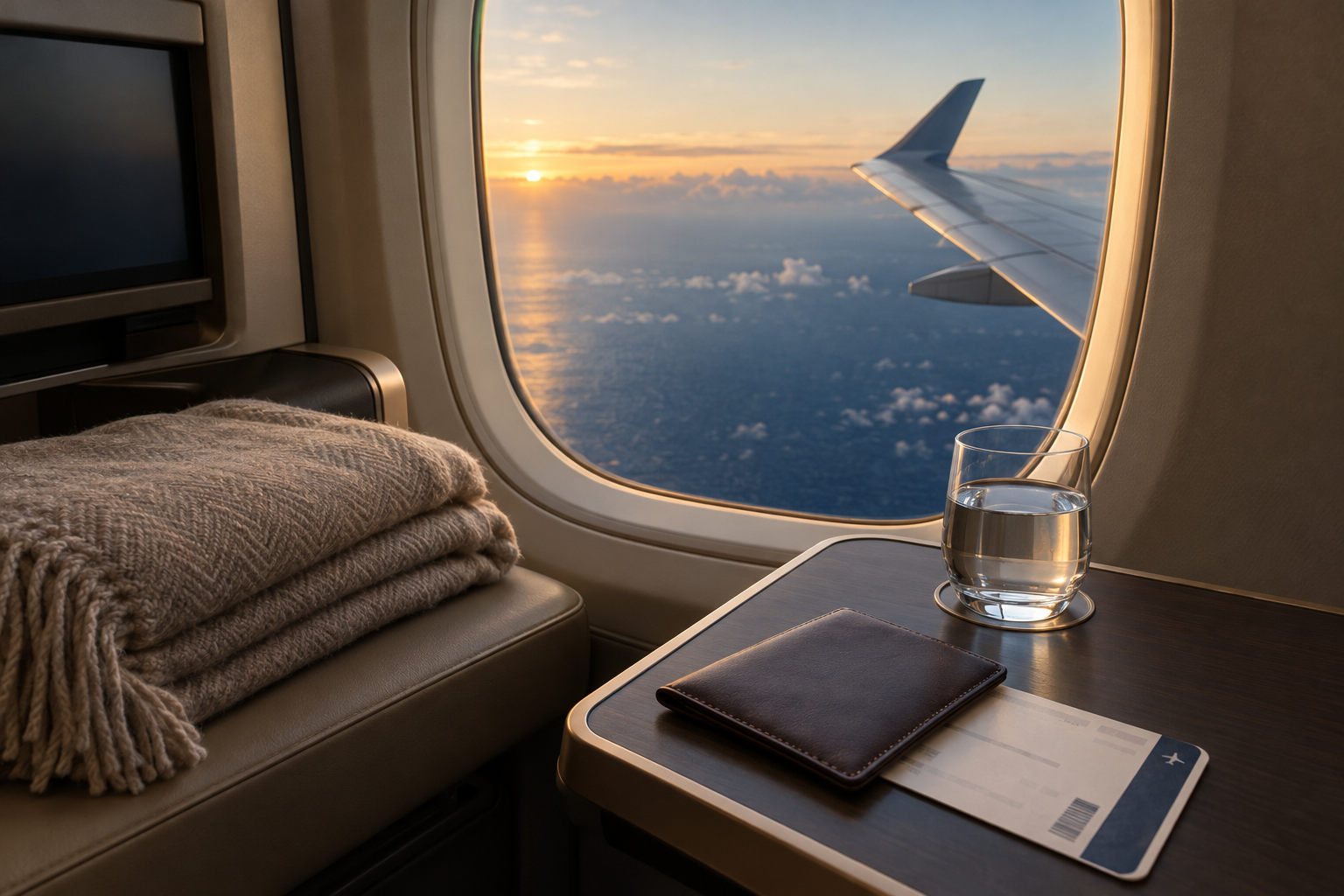
Australia is the award that separates the hobby from the habit. Anyone can find a domestic seat in economy with a few weeks notice. Getting two people to the other side of the world in a lie flat seat, on the same flight, in the same week, is a different sport. This is how we did it, what it cost, and the parts we got wrong.
- Award booking
- Business class
- Singapore Airlines
- Stopover
Part One
Why this one is hard
Nobody has spare seats to Australia
Distance, demand, and the saver space problem
Every long flight is a supply problem, and Australia is the far end of it. From the east coast of the United States it is roughly 20 hours in the air, usually in two pieces, and the number of carriers that can sell you a flat bed the whole way is small. Qantas, Singapore Airlines, Emirates, Qatar, ANA, Korean, United and Delta all do parts of it. The award seats do not care how many programs you belong to.
The second problem is saver space. Airlines release a small number of cheap award seats per flight, often one or two, and they are gone within minutes of the schedule opening. If you need two seats on the same flight, which we did, you are looking for a flight that released at least two. That cuts the pool again.
The award does not go to the person with the most points. It goes to the person who is awake when the schedule opens and flexible about which ocean they cross.
Part Two
The options
Three routes worth pricing
Over the Pacific, over Asia, or over the Middle East
We priced three ways of getting there, and all three are legitimate depending on what you have in your accounts.
Over the Pacific means Los Angeles or San Francisco to Sydney or Melbourne on Qantas, United or American. It is the shortest total travel time and the hardest award. Qantas releases very little to partners, United charges a lot for its own metal, and American saver space to Australia appears and disappears.
Over Asia means a long leg to Tokyo, Seoul or Singapore and then onward. It adds hours, and it is where the space actually is. Singapore Airlines in particular releases saver business seats to its own program more generously than to partners, which is why the transfer choice matters.
Over the Middle East means Doha or Dubai, then a long leg down. Qatar via Doha is a lovely product with painful taxes on some routings, and Emirates is easy to book but rarely cheap in miles.
What we chose
Washington to Singapore on a long leg, a two night stop, then Singapore to Sydney. It was not the fastest route on paper. It was the only one with two saver seats on the same aircraft in the same week, and the stop broke up the journey in a way we would pay for again.
Part Three
The numbers
What it actually cost
Miles, taxes, and the fees nobody mentions
These are the figures from our booking, made in February for a December flight. Programs reprice constantly and taxes move with exchange rates, so treat this as a shape rather than a quote. The shape is the useful part: the miles are the small number, the taxes are the surprise.
| Route | Miles per person | Taxes and fees | Space |
|---|---|---|---|
| USA to Singapore to Sydney | about 130,000 | about $190 | Two seats, found in February |
| USA to Doha to Sydney | about 95,000 | about $420 | One seat only, both dates we tried |
| Los Angeles to Sydney direct | about 80,000 | about $120 | Nothing released in our window |
The direct option looks cheapest per mile and it is also the one that does not exist when you need it. The Doha routing looked wonderful on paper until we added the fees, which pushed the cash cost past what we would pay for a discounted cash fare. We took the longer, quieter route with the low taxes.
The value, honestly
A cash business fare on the same dates was running about 7,000 dollars per person. At roughly 130,000 miles and 190 dollars in taxes, our redemption came out north of five cents per mile. That is a good day in this hobby, and it is also why we keep the miles.
Part Four
The plumbing
The transfer that makes it possible
Programs, ratios, and the two day gap
We book Singapore Airlines through KrisFlyer, which is a transfer partner of the major flexible currency programs. Points move at one to one from most of them, and the transfer is not instant. Ours took about a day, which is a day in which the seat you were looking at can disappear.
That gap is the single most common way people lose a good award. The rule we follow now: only transfer once the seat is on hold, or when the space is abundant and you can afford to lose it. Singapore Airlines will hold an award on the phone for a short period, which is exactly what that hold is for.
Keep an eye on transfer bonuses, too. The same points are worth 20 or 30 percent more during a promo, and those promos come around often enough that it is worth waiting a few weeks if your dates are not urgent.
Part Five
Timing
The booking window is the whole game
Eleven months out, at an awkward hour
Airlines open their schedules roughly 330 to 355 days ahead, depending on the carrier. The seats that matter are released at that moment, so the useful skill is not searching, it is being awake. We booked about eleven months ahead, at a time of day that no sane person chooses.
We used a paid award search tool to watch the route rather than checking the airline site by hand every morning. That is worth the subscription for a trip like this and not worth it for anything simpler. Set the alerts, then be ready to act the same day.
If you cannot book early
There is a second window. Airlines often release more saver space in the last two to six weeks before departure, when they know which seats will go empty. It is a real option for flexible travellers and a bad plan for a cruise with a fixed sail date.
Part Six
The bonus
The stopover you should not skip
Singapore for two nights, on the way
The route we booked passed through Singapore, and Singapore Airlines allows a stopover on many award itineraries for a modest fee, sometimes none at all depending on the fare. We took two nights, which turned a brutal journey into two pleasant flights with a city in the middle.
It also solved the jet lag problem in a way that no amount of in-flight strategy ever has. Arriving in Sydney after two days on Singapore time felt like a short domestic hop rather than the end of a very long haul.
Part Seven
The honest part
What went wrong
Four mistakes, in order of expense
- We transferred points before the seat was confirmed on one attempt. It worked out, because the space was there, but it could have stranded 100,000 points in an account we did not want to use.
- We searched one-way first and assumed the return would be easy. It was not. Return space to the United States is tighter than the outbound, and we ended up booking the return separately, later, at a worse rate.
- We ignored the taxes on the Middle East routing until the last comparison. Four hundred dollars a person changes the maths on a redemption that looks cheap in miles.
- We did not check the seat map. Two seats in business on the same flight can still be one behind the other in a staggered layout, which is not what you want on a 15 hour leg.
The miles are the easy part. The hard part is wanting two seats, on one flight, in one week, and being willing to fly the long way around to get them.
Part Eight
Copy this
The playbook
What we would do again, in order
- 01Decide the route shape first, not the airline. Pacific, Asia or Middle East, then work out who flies it.
- 02Find which of your transferable currencies reaches the program that releases the space. Do not transfer yet.
- 03Set award alerts on the route for two passengers, business, and let them run for weeks.
- 04When space appears, put it on hold by phone if the program allows it, then transfer the points.
- 05Price the taxes before you commit. A cheap award with heavy fees is often worse than a discounted cash fare.
- 06Add a stopover if the program allows one. It costs little and turns a hard journey into a good one.
- 07Book the return at the same time if you can. Waiting is how the trip gets expensive.
That is the whole method. It took us about three months of watching and one awkward phone call, and it put two lie flat seats to the other side of the world within reach of a normal points balance. If you are planning the same trip, start watching now, and write the lowest fare you would accept before the space appears. Decisions made in a hurry at midnight are how points get spent badly.